Thoughts on the 2026 General Assembly

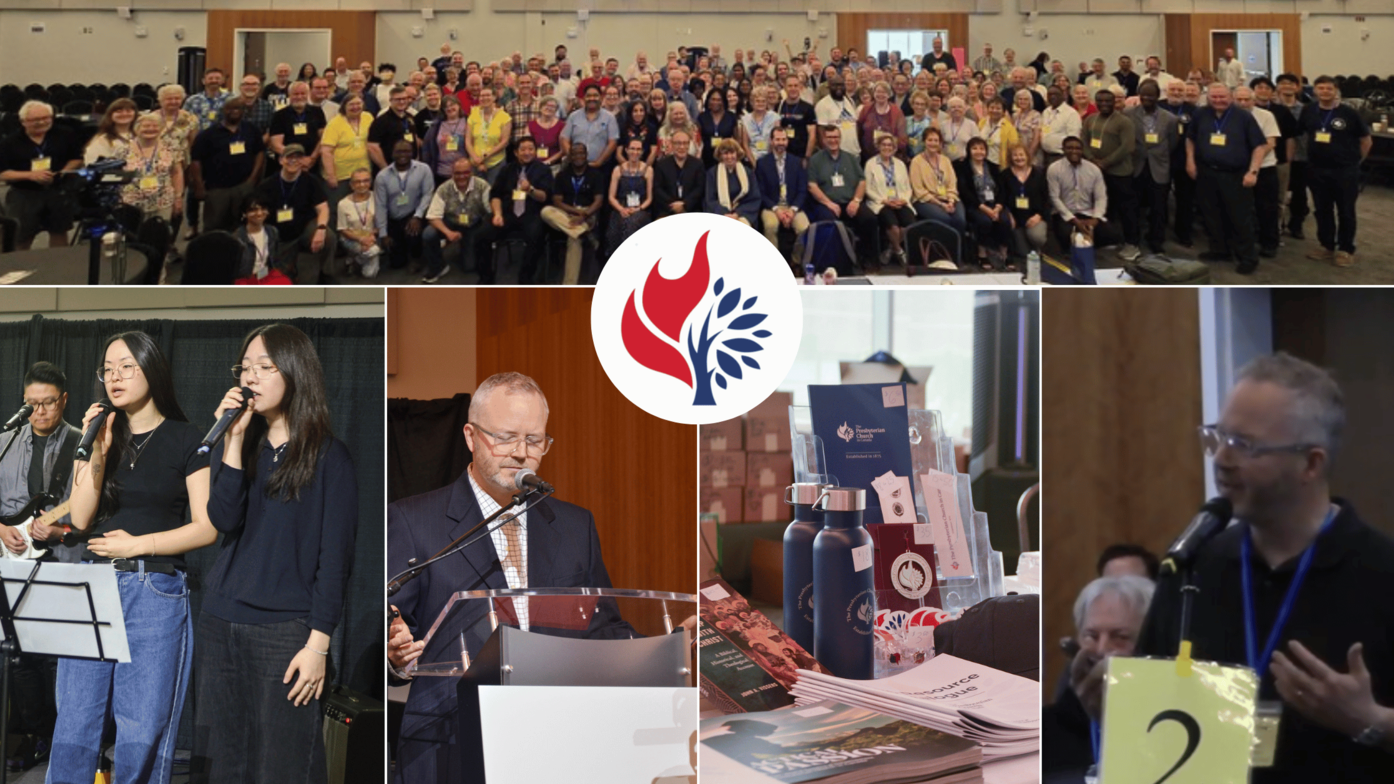
Recently, I spent five days at the General Assembly (GA) of The Presbyterian Church in Canada. This is the denomination’s highest decision-making body.
The GA meets annually and is made up of commissioners from across the country. Commissioners are simply pastors or elders from local congregations who attend on a rotational basis. I attend once every five-ish years.
So, what happens at a GA?
A national moderator is elected. He or she runs the meeting with the assistance of two clerks. They were organized and did a good job.
There are also times of worship. As a pastor who usually leads worship, it is nice to sometimes be in the congregation.
There were special speakers from various parts of the world. Sometimes these are ecumenical partners from other parts of the church, and sometimes they are speakers on topics that are relevant to this moment in the church’s life.
One of the speakers was from Bethlehem. Yes, that’s right. He lives in the actual Bethlehem. We even had breakfast together one day. His name is Nader Anton Abuamsha and he works for the Department of Service to Palestinian Refugees as a part of the Middle East Council of Churches. He flew to Canada to address the denomination about their work. Modern day Bethlehem is smaller than Barrie. The Church of the Nativity dates to the 300’s and is said to be built over the birthplace of Christ.
Most of the GA consists in dealing with reports that are produced by various national committees such as Assembly Council, the Life and Mission Agency, the Committee on Church Doctrine, etc. Much of this work is in response to requests from across the denomination (a process which occurs through lower courts of the church, whether that be sessions or presbyteries) to address certain issues, problems or questions.
Let me highlight what I think was most significant about GA:
The Change Leadership Team
First, there is a special commission called The Change Leadership Team (CLT). To quote my colleague Heather Malnick who is a part of this team: “The purpose of the CLT is to bring helpful change to our structure allowing our congregations, agencies, and special ministries to spend more time and energy on our focus – to share the Good News of Jesus Christ with others. To this end, the CLT has been tasked with creating a more streamlined structure, freeing us from some of the administrative tasks that may bog us down while providing much needed support during times of challenge.”
The CLT is set to report back in 2027. Therefore, at this year’s GA they only provided an update. It should be noted that this Team has special authority to simply implement much of it’s work, instead of seeking approval from the wider church. To me, this is an indication that many congregations need urgent help and would not benefit from extensive delays. Note, however, that their work is not doctrinal in nature, but on how the church functions and operates.
Various Updates and Helps
Second, a number of updates occurred in various aspects of the church’s life. I won’t name them all, but there were some modifications to procedures to help people who are leading churches who don’t have a full-time pastor, there were motions and amendments to do with possibly increasing the funding for our three seminaries (which are located in Vancouver, Toronto and Montreal), there were updates about the state of our church camping system for youth, there was discussion about appropriate uses of Artificial Intelligence, and also work related to international relief and mission projects.
Mission Award
Third, an annual mission award was given out to UpperLVL Worship and its organizer, Austin Penner. They are a growing faith community in downtown Nanaimo, British Columbia. They gather within LevelTwo Nightclub. It reaches out to people who might not otherwise get to encounter the good news of Christ. This was a definite highlight of the GA. If you want to hear about Austin’s conversion story, about his work, and about his hope for this ministry, you can watch his presentation to the GA by clicking here.
Assisted Suicide
Fourth, the most contentious part of the GA was the debate about MAiD (medical assistance in dying), also referred to as assisted suicide. Let me explain the reason this topic was raised, the denomination’s current stance, and then what happens next.
Please note that as I share this information, I will use the phrase “assisted suicide” not “MAiD.” I believe that the shift to this new term is intentional and underhanded. The words we use matter. The new phrase shifts the focus away from taking life, as if we are just providing “medical assistance” for those who are already dying. This change of wording is, in part, intended to influence our thinking about this practice, making us more favourable toward it. This is why I retain the phrase “assisted suicide.”
My comments will be quite brief relative to the enormity of this issue, and to the time spent on this topic at the GA.
A previous GA (2023) requested that the Committee on Church Doctrine provide a pastoral response to the rapidly changing landscape in Canada on assisted suicide. Their report said that it is a time of “grave moral testing” in our nation. The report reaffirmed the denomination’s previous position which stands in opposition to this practice, citing, among other things, the Lordship of Christ over life and death, the image of God and inherent human dignity, human life as a gift and trust from God, and the themes of suffering and hope.
Many commissioners (myself included) spoke to the issue. In the end, it was clear that there was a diversity of views on a challenging subject which has become very personal for many of us.
Several people expressed support for the denomination’s ongoing opposition to assisted suicide and its rapid acceleration and broadening in Canada. Several others expressed a desire for the denomination to be more open to the practice, citing cases of unique suffering. As one commissioner stated, “it is clear that we are not of one mind on this subject.”
The report was referred back for further work, but not to the Committee on Church Doctrine. It was sent to the Life and Mission Agency (LMA) in consultation with the Doctrine Committee. This too sparked debate. The hope of the movers of this motion was that the LMA will include a response which is more “pastoral.”
Ours is a life-giving God. Although there are certainly challenging and painful situations, we are called to do what the people of God have continually done for generations upon generations: we walk alongside those who are suffering, we pray, we provide hope, and we help individuals and families where able.
The Canadian government has put the moral responsibility for the taking of life in these situations on suffering individuals and their families. This was (and is) a grave mistake. Only God has the moral authority to decide when life is (or is not) taken.
So, what is the status of this discussion? In short, it is ongoing. The LMA will do their work and bring back another report to a future GA. Until then—and hopefully beyond—the official position of the denomination stands in opposition to this practice.
Before moving on, I want to share a word with those who perhaps don’t understand the radical scope of what is happening in Canada. We have become the “wild west” of assisted suicide. To quote Jonathan Griffiths as it relates to Canada’s unparalleled and hazardous acceleration of assisted suicide: “What began as a limited allowance for terminally ill patients has expanded beyond all recognition in a few short years, so that assisted suicide is now one of the leading causes of death in Canada, with the rate of deaths through assisted suicide growing at an annualized rate of over 30%.”
Yes, Canada is now the world “leader” in assisted suicide. Many doctors are alarmed, and many abscond themselves from the referral process. Mental health practitioners are alarmed, especially as the government seeks to make this a “treatment option” for people who are experiencing mental illness.
Can you imagine how harmful it would be to someone dealing with a mental health issue if they were told they could just end it all by government-sponsored suicide? At the GA, an individual spoke very passionately about their own struggle with bi-polar disorder. They said that in their darker moments, hearing a message like that could have been disastrous.
During one of the sessions, I highlighted the alarm of an organization called “Inclusion Canada,” who in May wrote to the Prime Minister urging him to stop the forthcoming legislation, not only for those suffering with mental illness, but with other disabilities.
For my part, one of the points I tried to make clear was this: Clarity is compassion which results in appropriate care. In other words, if we are not clear on whether or not a practice is biblically sanctioned (and therefore within the will of God), then we will not be acting with compassion, and the resultant care we provide will not be appropriate.
The Overall “Feel”
The GA was well-organized. I appreciated the times of worship and seeing some old friends from my days in seminary. I also appreciated walking around York University, reflecting on yester-year, since it was where I did my undergrad.
However, the denomination continues to be threatened by theological drift. The overall “feel,” at least to me, seemed like an organization who wants to follow Christ without honestly listening to what he actually says and does. This is not true for everyone, but for some.
In the 1800’s, Thomas Jefferson took his Bible and cut out certain stories. He retained only the moral teachings of Jesus. The result was the famed “Jefferson Bible.” When we pick and choose what we do (or don’t) like, aren’t we doing the same thing?
To me, the debate on assisted suicide was telling. If support for Canada’s haphazard and unbiblical approach is eventually approved, we will (ironically) be taking another step to euthanize the denomination.
The good news, however, is that God is on the throne, and there are many congregations who are focused on Christ and on his work on the ground. There are also faithful people up and down the denomination who are seeking God's will. Churches that align themselves with him and his mission in the power of the Holy Spirit will continue to march ahead victoriously in his grace and truth. Those who don’t, won’t.
A Prayer
Let me end with this.
I was honoured to be asked by my friend and fellow pastor Joe Bae to help with worship on the closing day of GA. I contributed the call to worship, the Bible reading, and a pastoral prayer.
Joe is a pastor at Vaughan Community Church. He preached about hope for the future and how God works in a variety of surprising situations. The praise team of St. Timothy Presbyterian Church from Etobicoke was inspiring, energetic and led three songs. It was an uplifting way to start the final day of GA.
Here is the prayer I led. I leave it with you:
Lord God the Almighty, you are a corpse-raising God.
Dust into flesh. Hope rising from pools of violent blood.
In you all things are actually possible.
Where we are stubborn and self-centred—you are wise.
Where we are foggy and distracted—you are steadfast.
Jesus, remember us (All: When you come into your kingdom)
Come, Holy Spirit.
Shatter our strategic plans and schemes
when they don’t align with the flight of your will.
So often we manoeuvre and doubt and decide—
as if the tomb was full, not empty.
Turn down the noise in our ears
and the disobedient cries from within
that are so at home in our flesh,
and re-calibrate our hearts.
Bring us into alignment with the frequency of a Father
who showers generosity on a world worth dying for.
Jesus, remember us (All: When you come into your kingdom)
Give us the kind of hope
that inflates our hearts with Christlike courage
in the face of a scheming, cocky adversary, the deceiving one.
Give us the kind of hope that drips
—no, oozes—from our churches
with food for the hungry,
healing for the fractured,
liberation for the demonized,
friendship for the lonely,
truth for a new generation who long to live under a banner that matters.
Give us such hope in the days to come
that it will soar unhindered from our churches, households, and hearts—
all for the glory of a shepherd who never sleeps
in the cause of his lambs and kingdom.
Jesus, remember us (All: When you come into your kingdom)
All these things we pray in the name of Jesus Christ—
raised ruling, renovating, soon to return,
Amen.
--------------------